
Unlocking Water Resilience Through Economic Tools: Read Our Second Joint Policy Brief
Europe’s water systems are under growing pressure from droughts, floods, pollution and scarcity, and the economic consequences are already being felt across agriculture, industry, ecosystems and communities. Addressing these challenges requires more than technical fixes: it demands innovative governance and the right economic tools, properly designed and combined.
The WaterGovernance2027 synergy group,bringing together three Horizon Europe research projects, InnWater, GOVAQUA and RETOUCH NEXUS, has published its second Joint Policy Brief. Building on the first brief, which highlighted innovative governance practices for water resilience, this second edition goes a step further by focusing on economic tools and how they can support water resilience in alignment with the EU Water Resilience Strategy (EWRS).
The brief presents a structured economic toolbox, covering price-based instruments, subsidies and Payments for Environmental Services, trading schemes, risk-management instruments, shared implementation arrangements, and blended finance, and highlights the essential role of economic and Water-Energy-Food-Ecosystems (WEFE) nexus modelling to support policymakers in designing, testing and implementing effective measures.
Our Key Messages on Leveraging Economics for Water Resilience
1
Innovative governance is an enabler for effective economic instruments.
Economic tools require clear regulatory frameworks, transparency, robust monitoring and stakeholder trust to avoid negative externalities and to support long-term water resilience objectives. Governance is not a backdrop to economic instruments, it is the foundation that makes them work.
2
A diversified economic toolbox is needed to balance efficiency, equity and resilience.
Price-based instruments, incentives, risk-management tools and cooperative arrangements should be combined and adapted to local and basin-level contexts. Explicit attention to affordability, access and water quality is essential to ensure that no one is left behind.
3
Economic and WEFE-nexus modelling supports informed and legitimate decision-making.
Integrated, data-driven modelling, co-designed with stakeholders including authorities, utilities, farmers, NGOs and citizens, helps assess trade-offs, distributional impacts and economy-wide effects. This strengthens both policy design and implementation, and builds the shared understanding needed for lasting change.
Contributors: Members of the Water Governance Synergy Group
Enhancing Water Resilience through Innovative Governance
Alice Jaraiseh
Author, Stockholm International Water Institute (SIWI)
Martin Henseler
Contributor, University of Bonn (URN)
Maria Vrachioli
Contributor, Technical University of Munich (TUM) - maria.vrachioli@tum.de
Suvi Sojamo & Liisa Saikkonen
Contributors, Finnish Environment Institute (SYKE) - suvi.sojamo@syke.fi
Esther Diaz-Cano & Julio Berbel
Contributors, University of Córdoba (UCO)
Julie Magnier & Ankinée Kirakozian
Contributors, Office International de l'Eau (OiEau) - j.magnier@oieau.fr
New Policy Brief: Leveraging Economics for Water Resilience
Unlocking Water Resilience Through Economic Tools: Read Our Second Joint Policy Brief Read Our Policy…
New Policy Brief: What “Nexus”? Towards Resource Nexus Standardization
Defining and Standardizing the Resource Nexus Despite growing recognition in academic and policy circles, the…
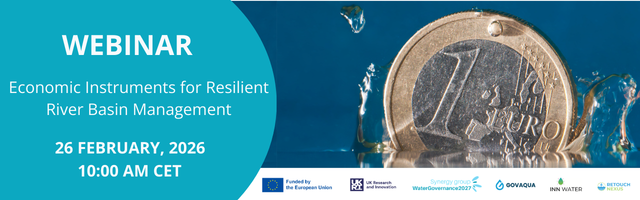
Building Resilience: Economic Instruments for Sustainable River Basin Management
Online – February 26, 2026 On 26 February 2026, the RETOUCH NEXUS project took part in the webinar "Economic Instruments for Resilient River…
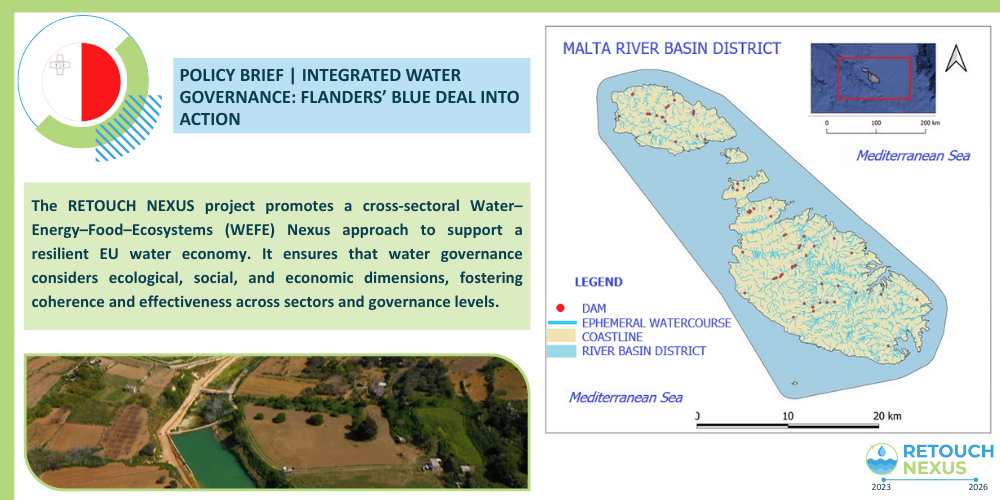
New Policy Brief: Pathways Towards Improved Integrated Water Governance in Malta
Integrated Water Governance in Flanders Malta confronts unique water governance challenges as a small, densely…
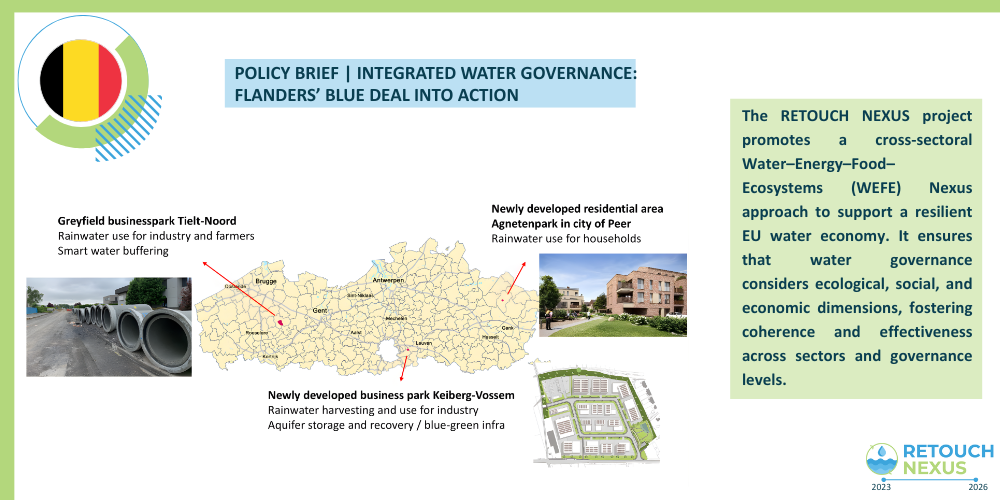
New Policy Brief: Integrated Water Governance – Flanders’ Blue Deal into Action
Integrated Water Governance in Flanders Flanders, Belgium faces growing water stress that threatens the reliability…
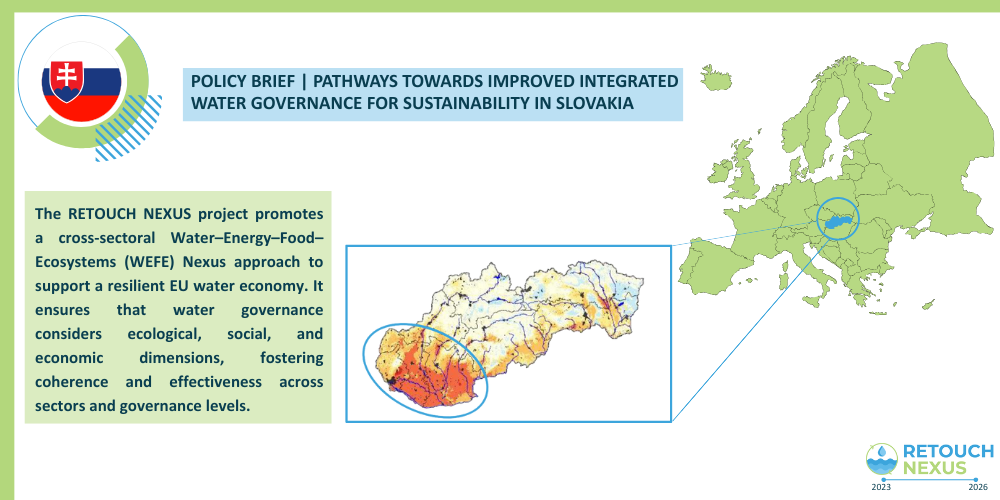
New Policy Brief: Pathways Towards Improved Integrated Water Governance in Slovakia
Integrated Water Governance in Slovakia Slovakia stands at a critical juncture as climate change exposes…
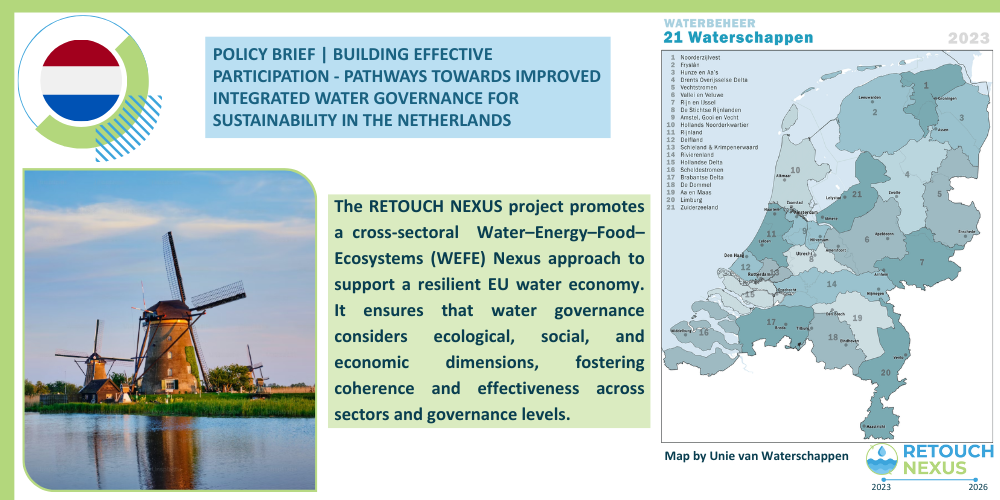
New Policy Brief: Building Effective Participation in Dutch Water Governance
Integrated Water Governance in the Netherlands The Netherlands faces increasingly complex water challenges driven by…
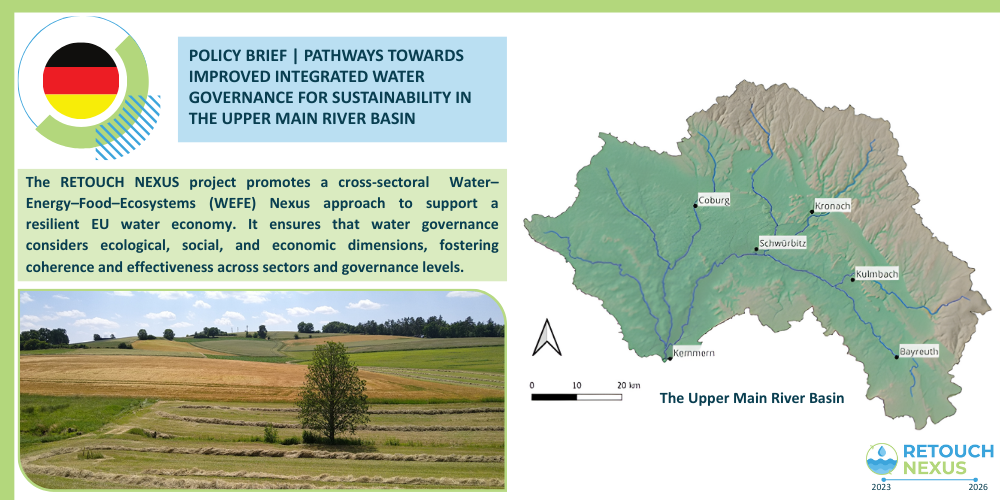
New Policy Brief: Pathways Towards Improved Integrated Water Governance in the Upper Main River Basin
Integrated Water Governance in the Upper Main River Basin The Upper Main River Basin in…
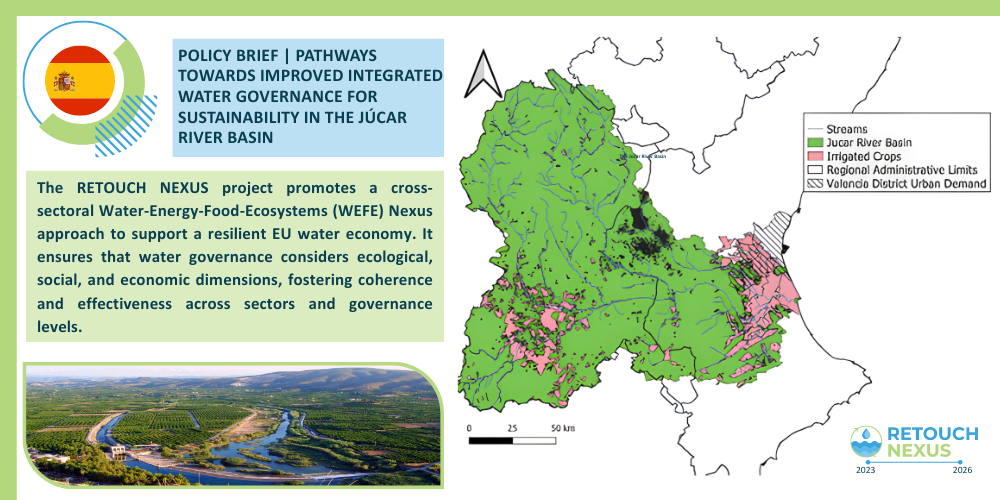
New Policy Brief: Pathways Towards Improved Integrated Water Governance in the Júcar River Basin
Integrated Water Governance in the Júcar River Basin: Turning Scarcity into Resilience The Júcar River…
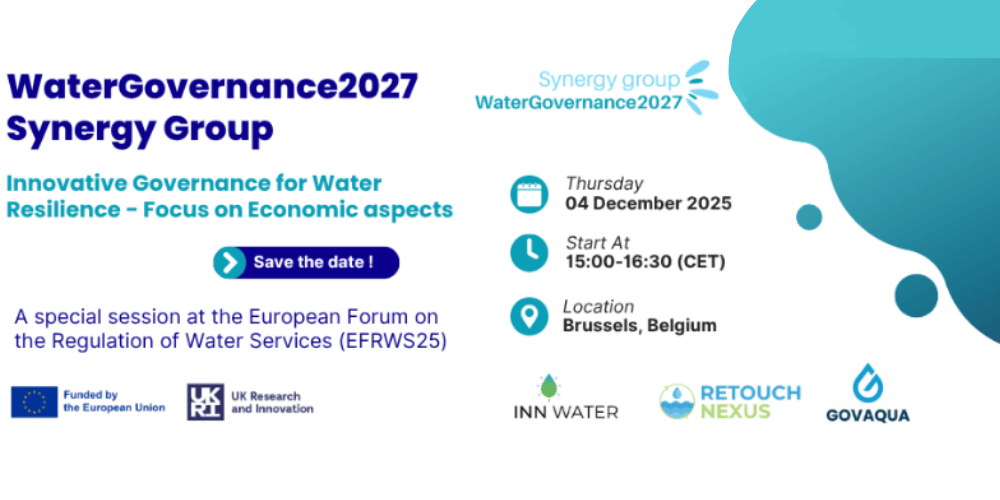
Strengthening Europe’s Water Resilience: Three Projects Unite at Brussels Forum
Brussels, Belgium – December 4, 2025 RETOUCH NEXUS joins InnWater and GOVAQUA to present unified…