
Defining and Standardizing the Resource Nexus
Despite growing recognition in academic and policy circles, the “Nexus” concept has long suffered from fragmented definitions, inconsistent governance structures, and insufficient practical guidelines, leaving it unable to translate into real-world impact. A new policy brief developed by UNU-FLORES and the PRIMA Foundation, with contributions from the wider Nexus research community including RETOUCH NEXUS coordinator Dr. Maria Vrachioli, directly addresses this gap. Responding to the outcomes of the Dresden Nexus Conference (April 2025), the brief calls for a clear, operational, and governance-ready definition of the Nexus, and sets out a concrete roadmap for standardization and certification of Resource Nexus projects.
Our Key Messages on Resource Nexus Standardization
1
The Resource Nexus must be understood as a broader framework that goes beyond the traditional Water-Energy-Food (WEF) Nexus. It should encompass soil, biota, marine ecosystems, material resources, and urban environments, remaining flexible and adaptive as new challenges emerge.
2
Environmental assets must be integrated with socio-economic systems. A genuine Nexus approach requires explicitly managing trade-offs and unlocking synergies across sectors, ensuring no policy advances one resource domain at the expense of another.
3
A Resource Nexus project must involve at least two interconnected resource systems and be anchored in strong, equitable governance. Marginalized voices must be heard, benefits shared fairly, and decision-making guided by robust, multi-stakeholder collaboration.
4
Transdisciplinary approaches are essential. Nexus initiatives must bridge policy, civil society, and practice, translating integrated analysis into actionable solutions at local, national, and international levels, and aligning with global agendas such as the SDGs.
5
A standardization and certification scheme for Resource Nexus projects is urgently needed. This requires harmonizing project design, assessment, and implementation criteria, enabling governments, funders, and international organizations to identify, compare, and scale high-impact initiatives with confidence.
Contributors: Authors of the Policy Brief
Prof. Floor Brouwer
Lead Author - UNU-FLORES, Germany floor.brouwer@unu.edu
Prof. Ali Rhouma
Lead Author — PRIMA Foundation, Spain ali.rhouma@prima-med.org
Dr. Maria Vrachioli
RETOUCH NEXUS Project Coordinator — Technical University of Munich, Germany maria.vrachioli@tum.de
Additional Authors
Daniel Karthe (UNU-FLORES, Germany) · Antonella Autino (PRIMA Foundation, Spain) · Bassel Daher (Texas A&M University, USA) · Edeltraud Guenther (UNU-FLORES, Germany) · Rabi Mohtar (Texas A&M University, USA) · Annette Huber-Lee (SEI, USA) · Zeeshan Tahir Virk (University of Oulu, Finland) · Chrysi Laspidou (University of Thessaly, Greece) · Nidhi Nagabhatla (UNU-CRIS, Belgium) · Claudia Ringler (IFPRI, USA) · Michael Jacobson (Penn State University, USA)
New Policy Brief: Leveraging Economics for Water Resilience
Unlocking Water Resilience Through Economic Tools: Read Our Second Joint Policy Brief Read Our Policy…
New Policy Brief: What “Nexus”? Towards Resource Nexus Standardization
Defining and Standardizing the Resource Nexus Despite growing recognition in academic and policy circles, the…
Building Resilience: Economic Instruments for Sustainable River Basin Management
Online – February 26, 2026 On 26 February 2026, the RETOUCH NEXUS project took part in the webinar "Economic Instruments for Resilient River…
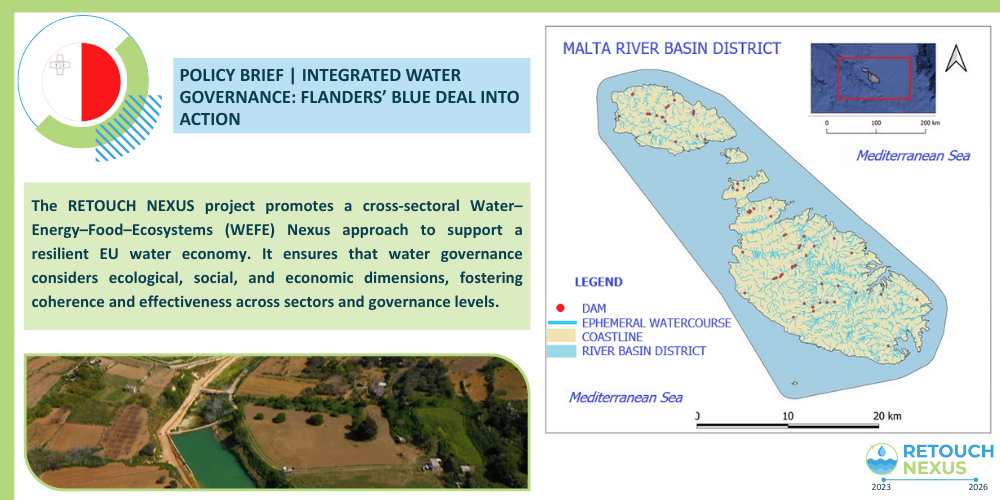
New Policy Brief: Pathways Towards Improved Integrated Water Governance in Malta
Integrated Water Governance in Flanders Malta confronts unique water governance challenges as a small, densely…
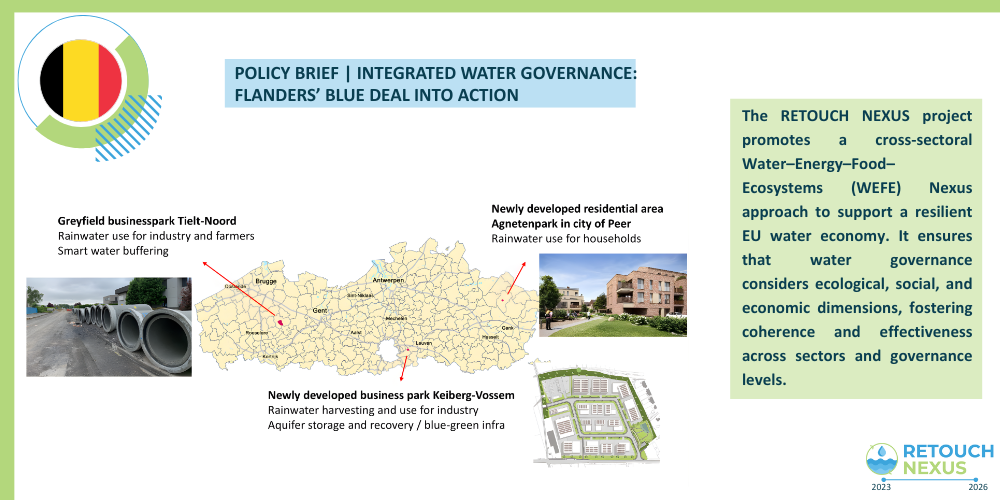
New Policy Brief: Integrated Water Governance – Flanders’ Blue Deal into Action
Integrated Water Governance in Flanders Flanders, Belgium faces growing water stress that threatens the reliability…
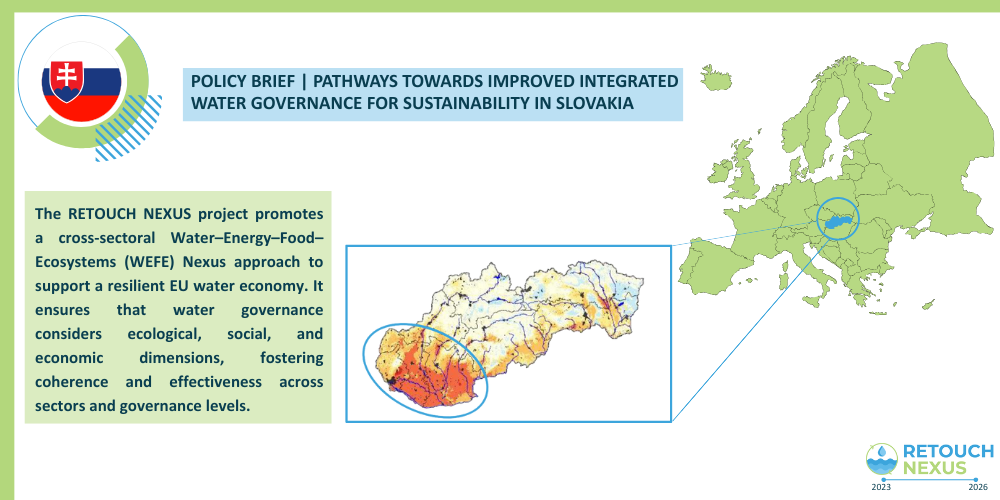
New Policy Brief: Pathways Towards Improved Integrated Water Governance in Slovakia
Integrated Water Governance in Slovakia Slovakia stands at a critical juncture as climate change exposes…
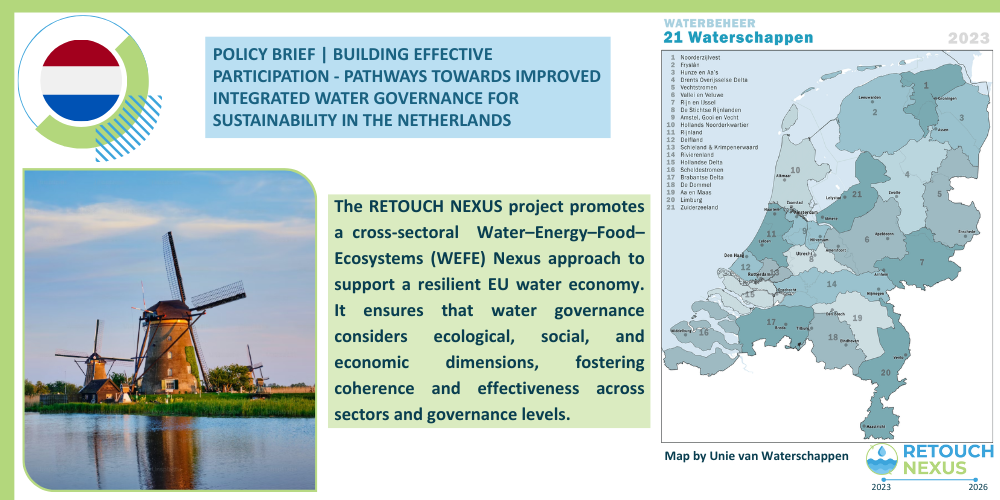
New Policy Brief: Building Effective Participation in Dutch Water Governance
Integrated Water Governance in the Netherlands The Netherlands faces increasingly complex water challenges driven by…
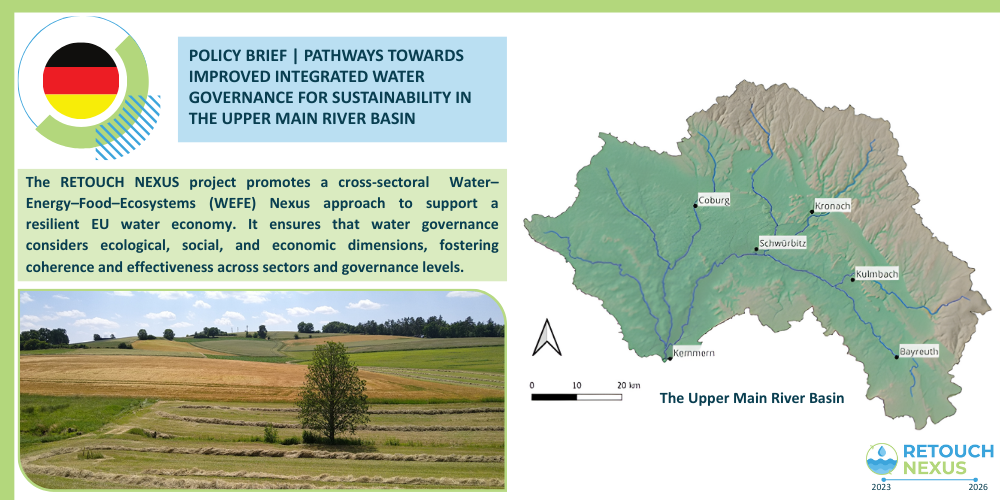
New Policy Brief: Pathways Towards Improved Integrated Water Governance in the Upper Main River Basin
Integrated Water Governance in the Upper Main River Basin The Upper Main River Basin in…
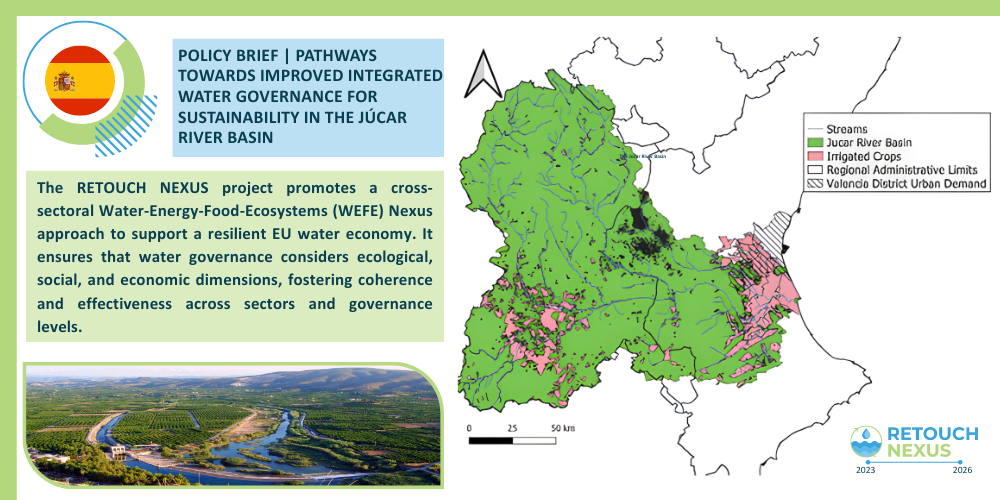
New Policy Brief: Pathways Towards Improved Integrated Water Governance in the Júcar River Basin
Integrated Water Governance in the Júcar River Basin: Turning Scarcity into Resilience The Júcar River…
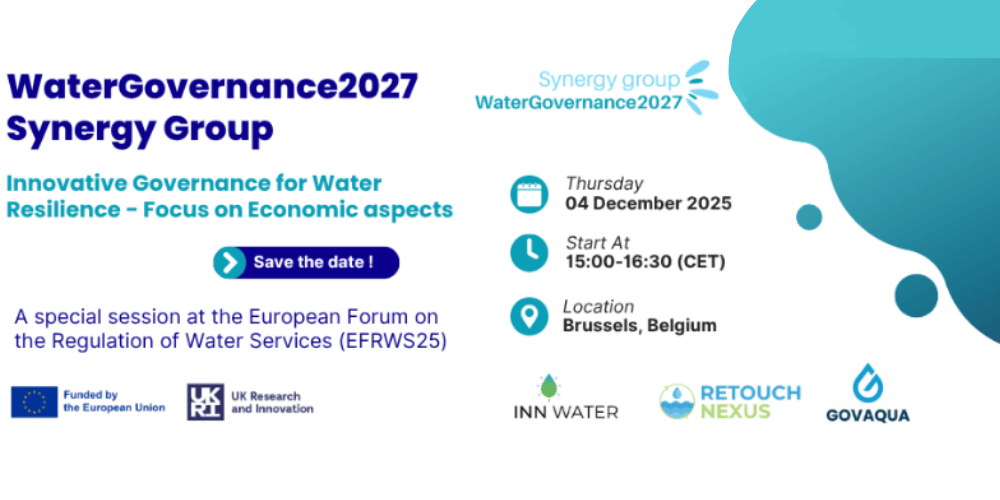
Strengthening Europe’s Water Resilience: Three Projects Unite at Brussels Forum
Brussels, Belgium – December 4, 2025 RETOUCH NEXUS joins InnWater and GOVAQUA to present unified…