
How can water policies better account for the complex interconnections between water, energy, food and ecosystems? A new scientific publication from the RETOUCH NEXUS project explores this question by proposing a unified framework that brings WEFE Nexus interdependencies, hydro-economic modelling and policy instrument design together.
Connecting Nexus thinking with water policy
Europe’s water resources are facing increasing pressure from climate change, water scarcity and competing demands. While the Water-Energy-Food-Ecosystems (WEFE) Nexus provides a way to understand these interdependencies, existing approaches do not always connect Nexus thinking with the economic and policy dimensions of water management.
The paper, “Bridging the Nexus: Policy and Welfare Dimensions in Hydro-economic Models“, authored by Leon Bremer, Erik Ansink, Safa Baccour, Cian Twohig, Juan Pablo Henao, Pietro Sala, Adria Rubio and Maria Vrachioli, addresses this gap by proposing a general framework for incorporating WEFE interconnections into hydro-economic models and explicitly linking them to policy instruments.
A framework for integrated policy analysis
The proposed framework systematically connects hydrological processes, economic behaviour, Nexus interdependencies and policy design. This makes it possible to assess not only how water is allocated, but also how different policy choices affect cross-sectoral trade-offs, welfare and environmental outcomes.
Importantly, the framework is designed to be modular and transferable. It can be implemented in detailed numerical models when extensive data are available, or adapted into more stylised applications where data and modelling capacity are more limited. This flexibility allows the approach to be applied across different river basins, sectors and policy contexts.
The framework also considers a range of economic instruments, including water pricing, tradable permits and payments for ecosystem services, providing a structure through which their impacts can be assessed from a Nexus perspective.
Insights from two European river basins
The framework is illustrated through two application in the Júcar River Basin in Spain and the Upper Main River Basin in Germany. These examples demonstrate how Nexus thinking can be incorporated into water policy analysis under different water management challenges and modelling conditions.
Rather than presenting the two cas studies as comprehensive representations of every WEFE interaction, the authors use them tyo demonstrate the adaptability and practical application of the proposed framework.
Supporting more coherent water governance
The publication highlights how bringing together economic, hydrological and ecological perspectives can help identify where private incentives diverge from broader societal objectives and assess how different interventions can address these gaps.
By providing a common conceptual structure for researchers, policymakers practioners, the framework contributes to the RETOUCH NEXUS ambition of moving towards more coherent transparent and resilient water governance.
The authors also identify opportunities for future research, including incorporating behavioural and institutional dimensions, more spatially detailed data, and dynamic feedbacks between ecological and economic systems.
Why it matters
As water pressures intensify, policies that address sectors in isolation may overlook important trade-offs and unintended consequences. This framework directly supports the objectives of the RETOUCH NEXUS project by helping connect hydrological, economic and ecological perspectives across the Water-Energy-Food-Ecosystems Nexus. In doing so, it provides a practical basis for evaluating policies more holistically and advancing the project’s goal of supporting fairer, more resilient and better-coordinated water governance.
New Publication: Optimal Water Pricing for Sustainable Agriculture and Electricity Cooling in the European Union
How can water pricing contribute to more sustainable and efficient water allocation across Europe? A new scientific publication from the…
New Publication – Bridging the Nexus: Policy and Welfare Dimensions in Hydro-economic Models
How can water policies better account for the complex interconnections between water, energy, food and ecosystems? A new scientific publication…
RETOUCH NEXUS Contributes to the Horizon Europe Reality Check on SHH Integration
On 27 November 2025, the European Commission's DG RTD organised the Reality Check on "Key success factors in the implementation…
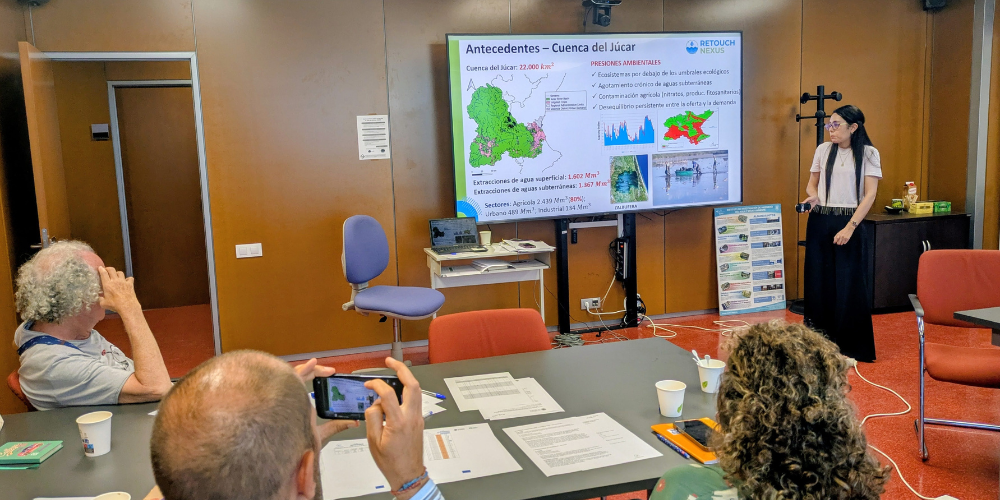
Validating Water Pricing Policies in the Júcar Basin: Highlights from Our Spanish Workshop
On Friday, 12 June, the RETOUCH NEXUS team brought together researchers and stakeholders in Valencia for a hands-on workshop dedicated to the Júcar River Basin. Putting the Hydroeconomic Model to the…
New Research: A Market-Based Alternative to “Polluter Pays” – Powered by Smart Contracts
We're proud to spotlight the latest publication from our partner Erik Ansink (Vrije Universiteit Amsterdam), co-authored with Jens Gudmundsson and…
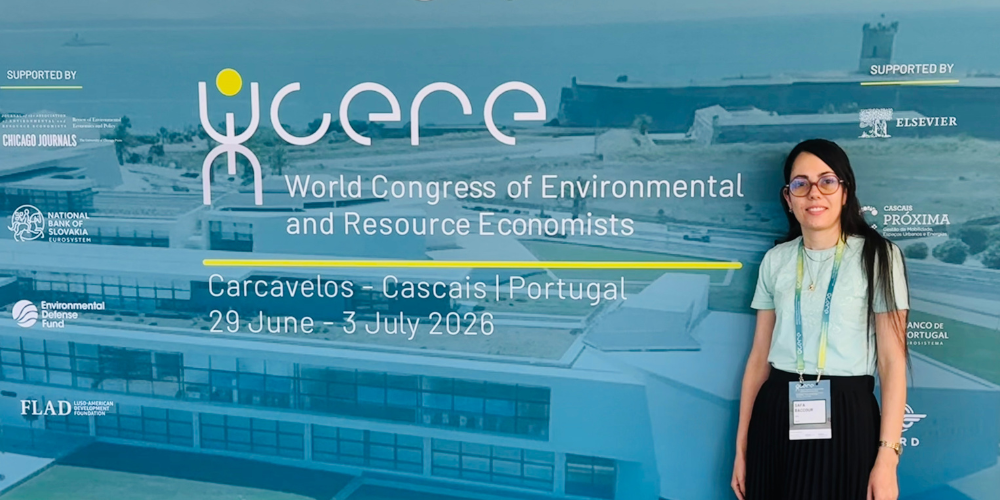
How Should Water Be Priced Under Climate Scarcity? RETOUCH NEXUS at WCERE 2026
RETOUCH NEXUS was represented at the 7th World Congress of Environmental and Resource Economists (WCERE 2026), held from 29 June…
How Should Water Be Priced in a Changing Climate? Safa Baccour Presents New Findings at EGU 2026
Research from the IIAMA institute explores how uniform and dynamic water pricing strategies can reduce unsustainable withdrawals, protect ecosystems, and…
New Policy Brief: Water Pricing
Pricing Scarcity at the River Basin Scale Traditional water allocation rules fail to reflect the true marginal value of water…
Pricing Water to Protect Nature: Our Partner Safa Baccour Presents at the International Conference on Climate Impacts in a Changing World 2026
We are proud to highlight the participation of our partner Safa Baccour from the Universitat Politècnica de València (UPV) at…
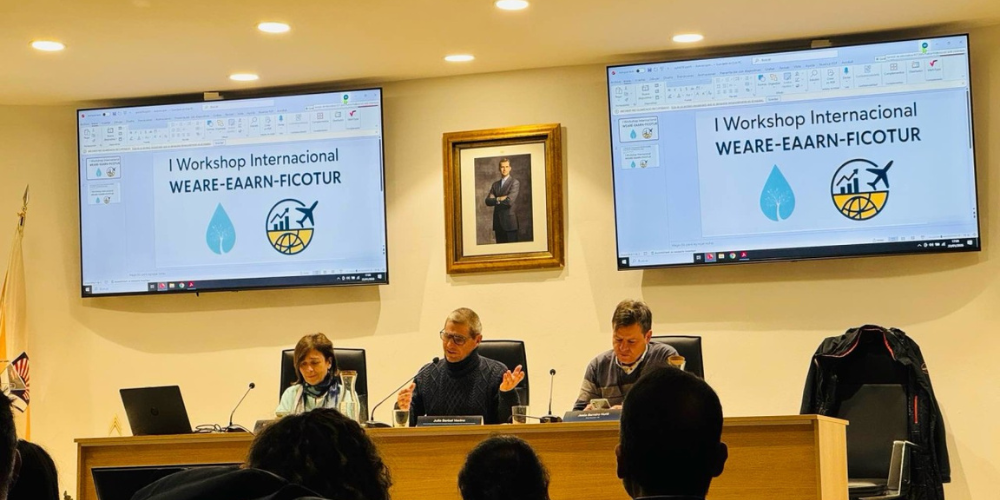
RETOUCH NEXUS Presented at the International Workshop WEARE-EAARN-FICOTUR in Córdoba
RETOUCH NEXUS was represented at the International Workshop WEARE-EAARN-FICOTUR: Establishing Networks, held on 22–23 January 2026 in Córdoba, Spain, within the session “Instruments and Policies…