
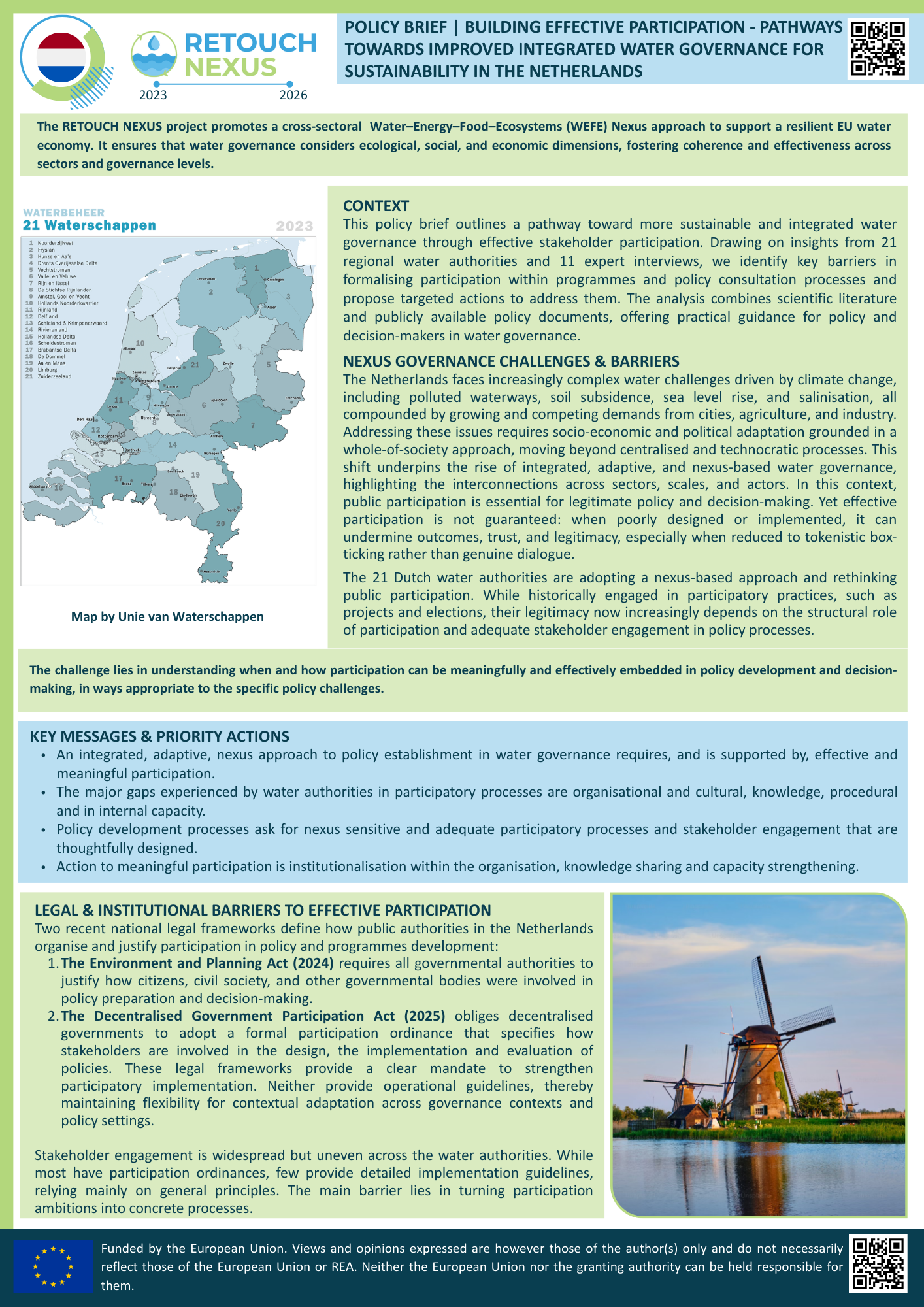
Geïntegreerd waterbeheer in Nederland
Nederland wordt geconfronteerd met steeds complexere wateruitdagingen als gevolg van klimaatverandering, vervuilde waterwegen, bodemdaling, zeespiegelstijging en verzilting, die nog worden versterkt door de groeiende vraag vanuit steden, landbouw en industrie. Hoewel het land een sterke traditie heeft op het gebied van participatief waterbeheer, schrijven nieuwe wettelijke kaders nu voor dat participatie structureel in beleidsprocessen moet worden ingebed en niet als een bijzaak mag worden behandeld. Deze RETOUCH NEXUS-beleidsnota, die is gebaseerd op een analyse van alle 21 regionale waterautoriteiten en 11 interviews met deskundigen, brengt de kritieke kloof tussen participatieambities en de praktijk aan het licht en biedt concrete wegen om symbolische afvinklijstjes om te zetten in een echte dialoog die geïntegreerd, adaptief en op nexus gebaseerd waterbeheer versterkt.
Belangrijkste boodschappen
1
Effectieve participatie maakt nexus-governance mogelijk: Een geïntegreerde, adaptieve aanpak van het waterbeleid vereist zinvolle participatie en wordt hierdoor ondersteund. Aangezien waterautoriteiten complexe uitdagingen aanpakken op het gebied van water, energie, voedsel en ecosystemen, moeten participatieve processen zorgvuldig worden ontworpen om rekening te houden met de onderlinge verbanden en adequaat te zijn voor de uitdaging.
2
Vier hiaten ondermijnen participatie: De belangrijkste belemmeringen zijn organisatorisch en cultureel van aard (participatie maakt geen integraal onderdeel uit van de beleidsvorming), kennisgerelateerd (versnipperde expertise zonder duidelijke verantwoordelijkheid), procedureel (onzekerheid over de structurering van processen) en capaciteitsgerelateerd (beperkt aantal opgeleide medewerkers, tijd en middelen).
3
Handel direct, niet achteraf: Participatie moet vanaf het begin van de beleidsontwikkeling worden ingebed als een structurele, bewuste keuze. Vroegtijdige reflectie en een duidelijke probleemformulering helpen bepalen wanneer participatie nodig is en bieden houvast bij het ontwerpen van een passend ontwerp voor contextspecifieke uitdagingen.
4
Interne capaciteit en cultuur opbouwen: Waterautoriteiten moeten de bestaande expertise van milieu- en gebiedsbeheerders mobiliseren, interne participatienetwerken opzetten, opleidingen organiseren en leerplatforms creëren voor het delen van instrumenten en ervaringen tussen afdelingen en organisaties.
5
Continu monitoren, leren en aanpassen: Effectieve participatie vereist het bijhouden van zowel resultaten als ervaringen van belanghebbenden, het vastleggen van hoe input wordt toegepast, het uitvoeren van reflexieve evaluaties en het delen van lessen tussen teams om collectieve kennis op te bouwen en de praktijk in de loop van de tijd te verbeteren.
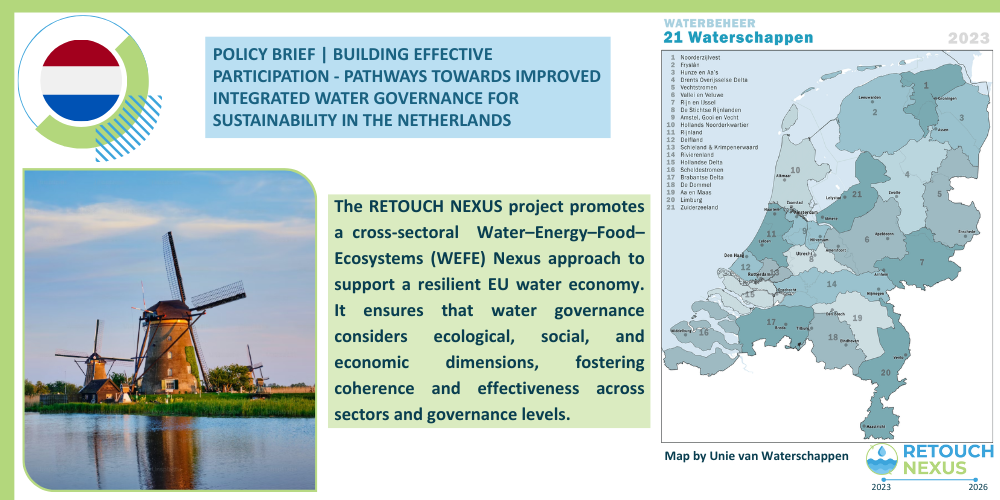
Nieuw beleidsdocument: Effectieve participatie in het Nederlandse waterbeheer bevorderen
Integrated Water Governance in the Netherlands The Netherlands faces increasingly complex water challenges driven by…
Informative evening for HHNK’s Freshwater Availability Programme
On Thursday, 11 September, the water authority Hoogheemraadschap Hollands Noorderkwartier (HHNK) held an information evening…

🤝 Building a Participatory Path for Water Governance in North Holland
RETOUCH NEXUS supports stakeholder engagement for the Freshwater Availability Program. In response to the growing…

Addressing Water Scarcity in the Netherlands: Insights from the RETOUCH-NEXUS Project
Water scarcity is an increasingly pressing issue in the Netherlands, driven by the dual challenges…

New Publication: Exploring Fair and Sustainable Pollution Management by our Project Partner VUA!
We are delighted to announce a new publication by our project partner, Vrije Universiteit Amsterdam…
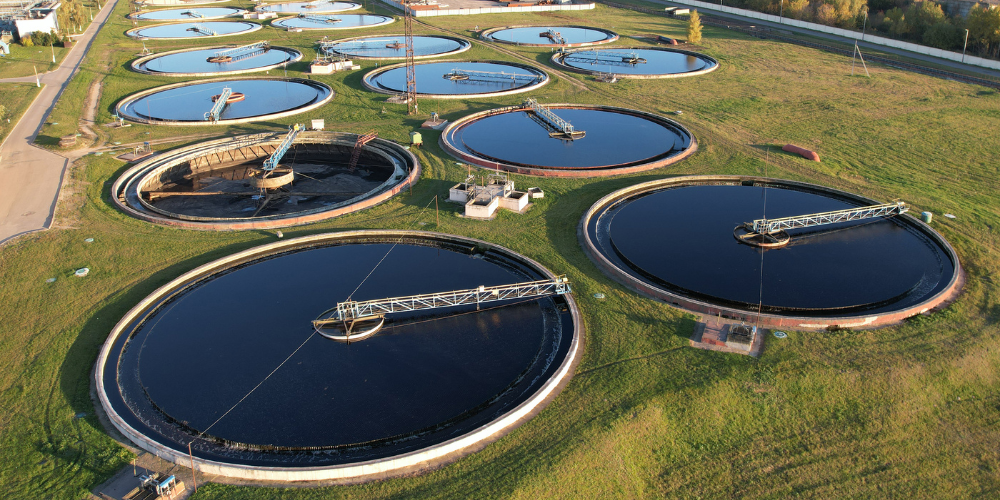
Establishing a baseline to characterise each RETOUCH NEXUS case study
Last September, our project completed two tasks aimed at exploring water governance models, institutional frameworks…