Online – February 26, 2026
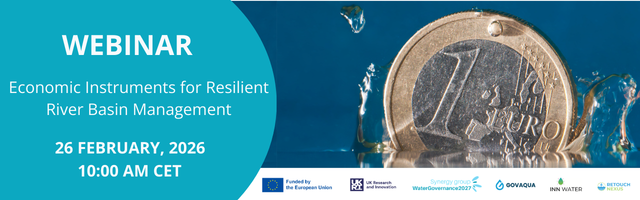
On 26 February 2026, the RETOUCH NEXUS project took part in the webinar “Economic Instruments for Resilient River Basin Management,” organised as part of the WaterGovernance2027 Synergy Group, which brought together three complementary EU-funded projects: RETOUCH NEXUS, INN WATER, and GOVAQUA.
The webinar gathered researchers and water management practitioners to explore a range of economic instruments for more sustainable and resilient river basin governance. Alongside presentations from GOVAQUA on water markets in Spain and from InnWater on integrating environmental and resource costs into water tariffs in Italy, RETOUCH NEXUS contributed a dedicated session on water pricing as a lever for environmental sustainability.
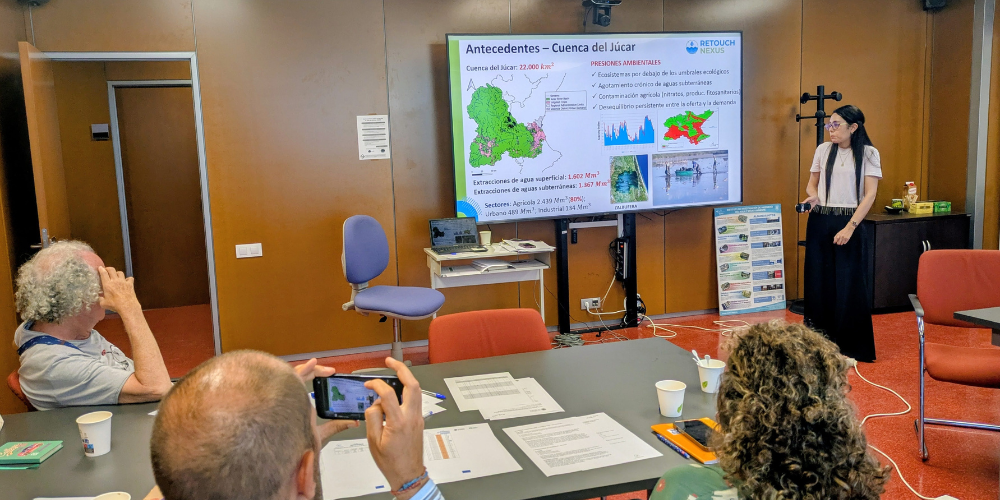
Safa Baccour (Universitat Politècnica de València) and Pietro Sala (Technical University of Munich) presented the project’s research on water pricing mechanisms designed to internalise environmental externalities and strengthen the resilience of aquatic ecosystems. Drawing on case studies from Spain and Germany, they showed how scarcity-responsive tariffs can encourage more sustainable water use and help address increasing pressures on river basins.
The session was followed by a Q&A moderated by Julie Magnier and Chloé Déchelette (OiEau), during which participants exchanged perspectives on how such pricing approaches could be adapted and scaled across different river basin contexts, a rich discussion that underscored the value of cross-project and cross-sector collaboration in advancing water governance.
This webinar was organized by the WaterGovernance2027 Synergy Group in partnership with the European Rivers Network.
Watch the recording
Together, the GOVAQUA, InnWater and RETOUCH NEXUS projects aim to address Europe’s water challenges by developing, assessing, and validating effective governance practices. The cluster tests innovative mechanisms and approaches to enhance water governance across 17 diverse locations throughout 13 EU Member States. These sites range from agricultural regions to urban areas and local catchments to national-level initiatives, creating a comprehensive framework for sharing knowledge and scaling best practices across Europe.